If you read nothing else
- From November to March, Skywings checks flyers in at its office in the pink Savoy building instead of the summer desk by Restaurant Schuh, a sign winter is a normal season here, not a gap.
- A flight over the valley floor and slopes under snow is the version many people prefer to the summer green, and the launch above Beatenberg runs it the same way all year.
- The air over the valley behaves differently through the day and through the year, and the weather on the morning itself decides whether a flight goes, in any month you pick.
- Free cancellation is offered, so putting the flight early in your stay gives a day moved for weather somewhere else in your trip to land instead.
Yes, You Can Fly in Winter
Tandem paragliding above Interlaken does not stop when the leaves come down, and the clearest proof of that is not a claim, it is an address. From April to October, Skywings meets flyers at its desk at the landing area, in front of Restaurant Schuh on Höheweg. From November to March, that changes: check-in moves to the Skywings office on the corner of the landing field, on the bottom floor of the pink Savoy building.
An operator does not keep a second office open for five months of the year by accident. The launch above Beatenberg is the same launch, the landing on the Höhematte is the same field, and the 1 hour 30 minute booking is the same length. The only thing that moves with the season is which door you walk through before you go up. That is not a small detail to get right if your trip falls in December, or in any of the months either side of it.
A Flight Over Snow, Not a Consolation Prize
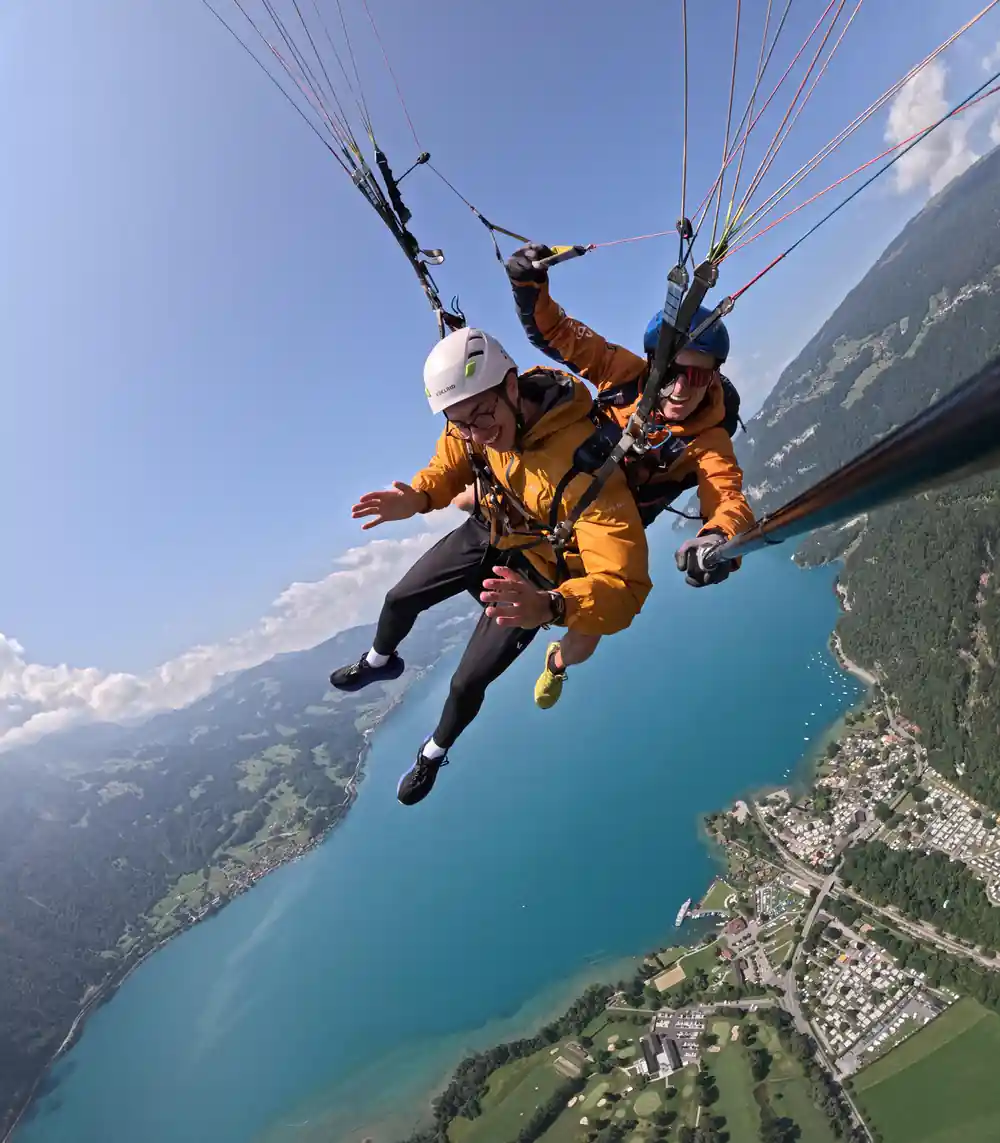
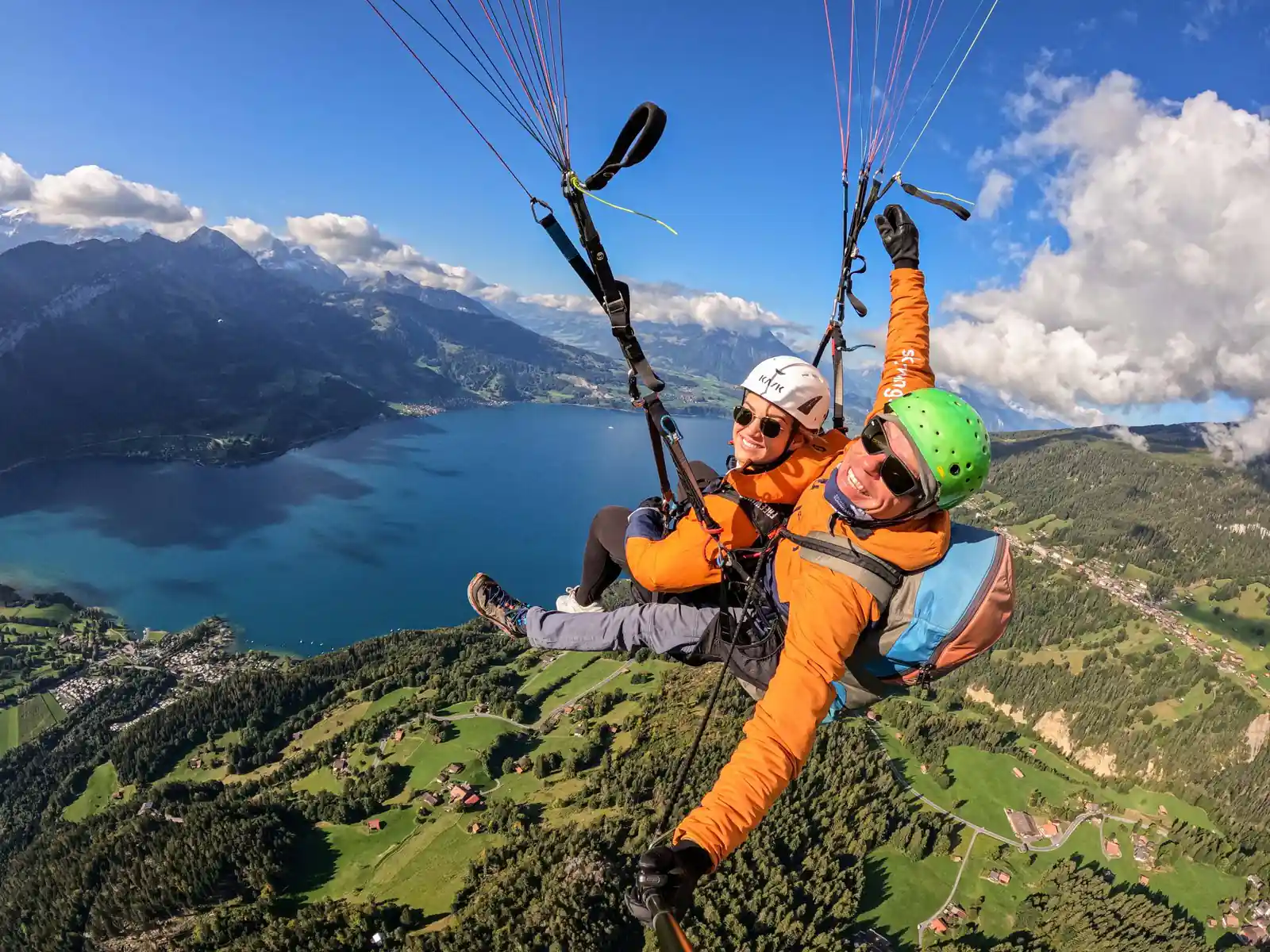
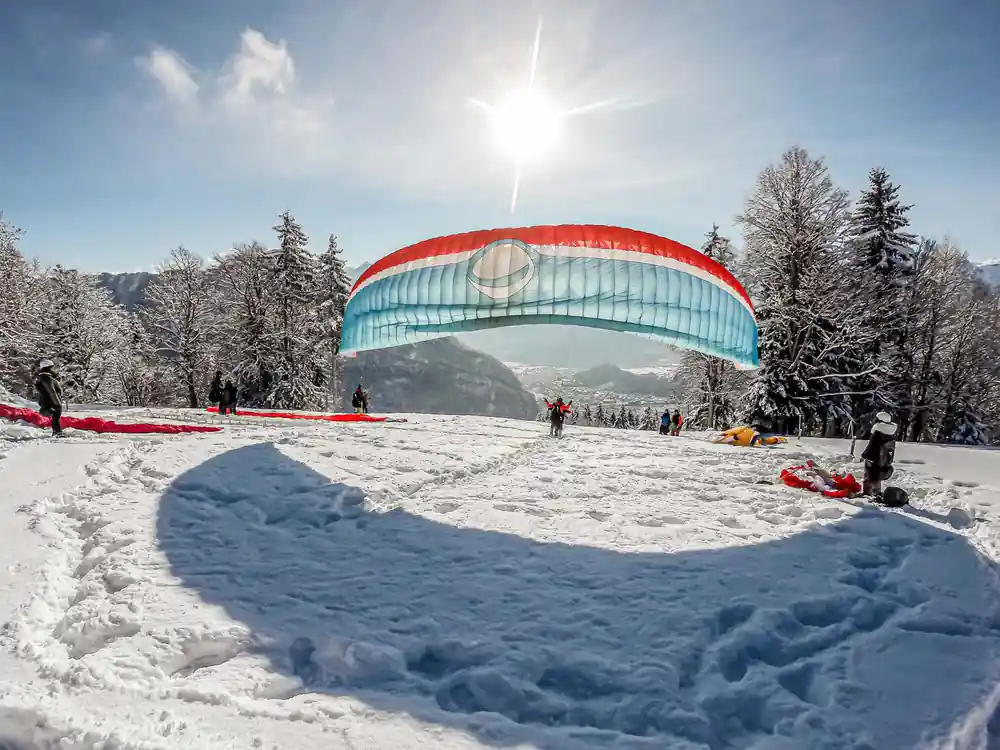
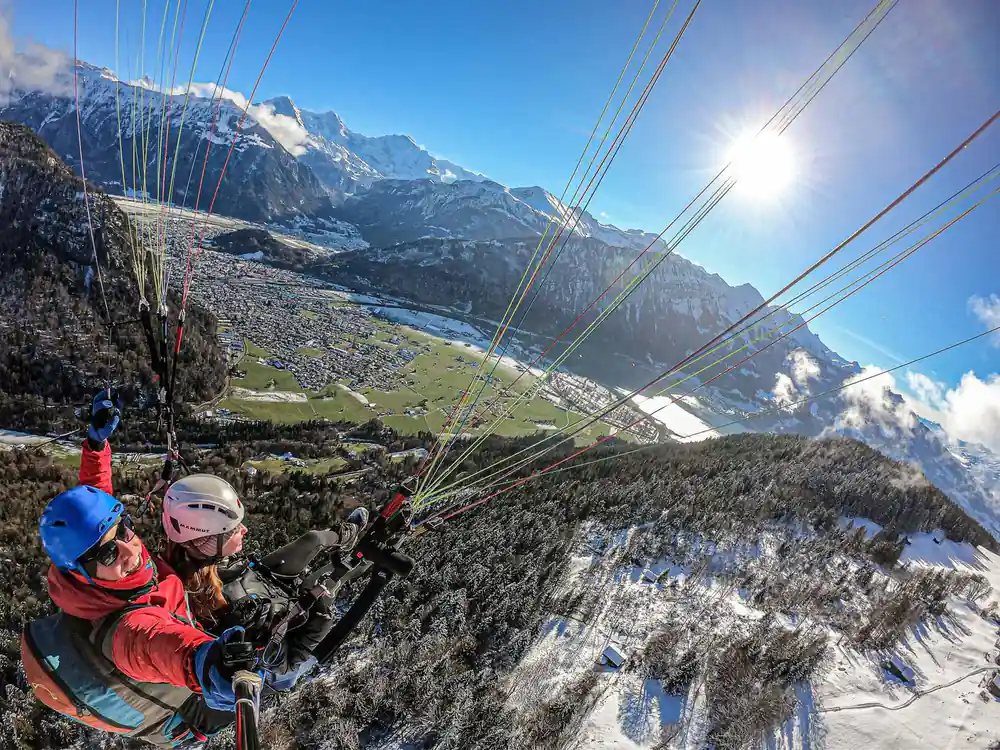
Most people picture paragliding over a green valley, but a flight over snow is the version plenty of pilots and passengers rate above it. Interlaken sits on the flat ground between Lake Thun and Lake Brienz, with mountains rising on both sides and the Jungfrau massif standing at the head of the valley to the south. Under snow, that whole scene reads completely differently to how it reads under grass, and which version you get depends only on when in the year you book, never on any change to the route below you.
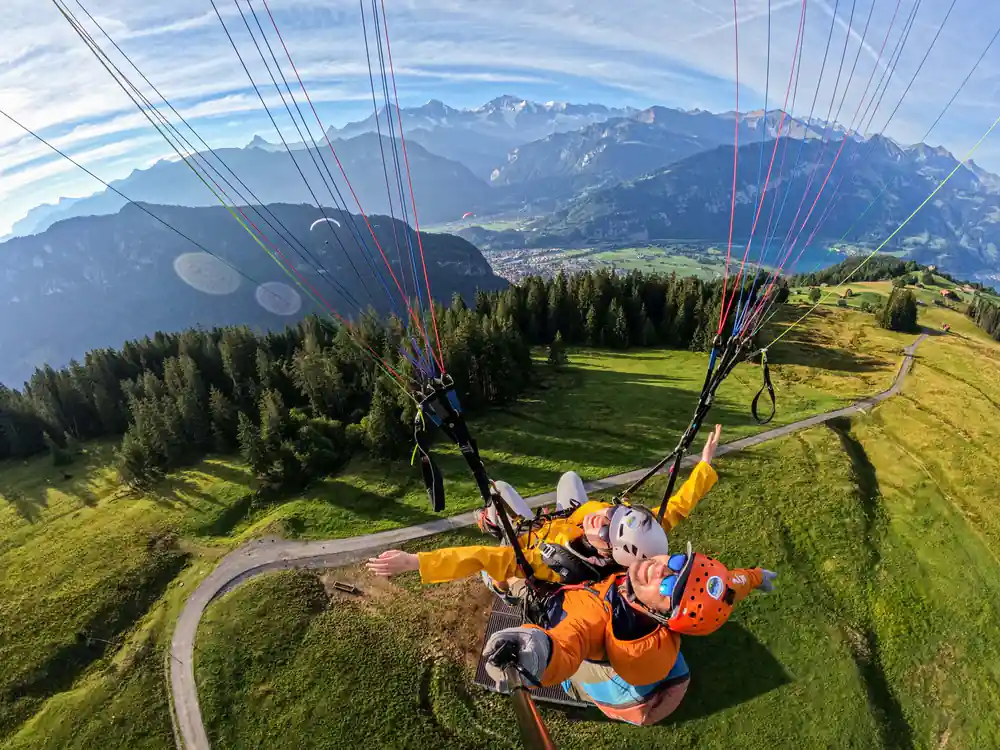
Nothing about the flight itself is scaled back for the season. It still launches from the slope above Beatenberg, still runs down towards the Höhematte, the public meadow in the middle of town, and still lands where the summer flights land. What is under you changes. What you get does not.
The Höhematte in winter: the same landing field, under snow instead of grass.
The Shoulder Months: March and October
October sits inside the warmer-season block, April to October, so a flight booked that month still starts at the desk in front of Restaurant Schuh. March sits on the other side, inside the November-to-March block, so the same trip booked a few weeks earlier starts at the Savoy building instead. Neither month is treated as a special case by the operator. Each simply falls on one side of a line drawn for the check-in address, not for the flying.
What that means for a traveller is simple: work out which side of the line your date falls on, and you know which door to look for. The flight, the launch above Beatenberg and the landing on the Höhematte do not change between the two. Only where you present yourself beforehand does. A trip that lands right on the turn of the season is the one case worth checking twice before you set off.
What Changes Through the Day
The air above a valley is not the same thing at nine in the morning as it is mid-afternoon, and that is true in July as much as it is in January. It settles and stirs through the day as conditions on the slopes shift, and that pattern moves again with the season, which is one reason a launch works with a pilot on site rather than a timetable fixed months out.
It is also why no single hour gets promised as the good one. A pilot who has watched that valley since first light that morning knows more about the next hour than any general rule about time of day, and that stays true whether the ground below is grass or snow. That kind of local knowledge is worth more than any general rule of thumb, in December as much as in June.
5 months
That is how long the winter check-in runs, at the Skywings office in the pink Savoy building, before it moves back to the summer desk in April.
What Weather Decides
Every flight, in every month, is decided by conditions on the day, not by the season on the calendar. A clear, settled morning in what is meant to be the quiet time of year can fly, and an unsettled afternoon in what is meant to be the reliable stretch can sit on the ground. The season sets which building you check in at. It does not set whether the day itself will fly.
That uncertainty is exactly why free cancellation is offered on the booking. It is the practical answer to a flight that cannot be scheduled with total confidence months in advance, and it means a date that does not work out on the day is not a date you are stuck holding.
Booking It Into Your Trip
The single most useful piece of planning advice for this flight has little to do with the season: book it early in your stay, not on your last free day. A flight that has to move for weather then has somewhere to go, another day still ahead of you, rather than running out of trip before the sky cooperates. It is a small piece of planning, and it is the one lever you actually control once the flight itself is booked.
Free cancellation being offered means that flexibility is simply there for the taking. Set the flight for early in your time around Interlaken, keep a spare day open if your trip allows it, and let the pilot make the call on the morning rather than trying to guess it from home beforehand.
See Interlaken From Above, Whatever the Season
from US$223Reserve now & pay later